
Biodiesel Distillation
Put Your Cold Soak Concerns to Rest with SRS Biodiesel Distillation
Biodiesel quality continues to be a concern for diesel engine makers, fleet managers, and the public in general. Variability in the quality of biodiesel, coupled with the high cloud point of biodiesel produced from certain feedstocks, has resulted in the ASTM adopting more stringent biodiesel standards. In October 2008, the ASTM revised the ASTM D7501 standard, requiring all finished biodiesel to pass a cold soak filtration test. This new testing requirement was designed to improve the cold weather performance of biodiesel.
What Does the ASTM D7501 Cold Soak Filtration Test (CSFT) Mean?
The test to determine cold soak properties is now ASTM D7501 — a standard test method for determination of fuel filter blocking potential of biodiesel (B100) blend stock by cold soak filtration test (CSFT). This test measures how well biodiesel flows when chilled then poured through a filter. Biodiesel that may have passed previous ASTM tests may fail this one because feedstocks with high gel-points inherit this attribute. Worse yet, homogenized oils or feedstocks blended from many sources can have gel points that vary from sample to sample. Yellow grease, white grease, and waste vegetable oil (WVO) all fall into this category.
There are really three approaches:
- Select feedstocks that have low gel-points (Soy for instance)
- Use fuel additives to lower the gel-point of existing feedstocks
- Improve the cold filterability by distilling your biodiesel
Switching to soy can be expensive. Fuel additives can help, but add significant and recurring costs. Distilling your biodiesel produces the purest form possible and dramatically reduces cold filterability for most feedstocks. Another advantage of distilled biodiesel is that no further washing is required, so dry washing (Ion Exchange or Magnesol) is unnecessary.
Advantages of Biodiesel Distillation
- Creates product homogeneity
- Creates a superior biodiesel when using both virgin and animal feedstocks
- Market differentiation by creating the purest biodiesel possible
- Takes sulfur out of high sulfur feedstocks like beef tallow and chicken fat (up to 80 PPM)
- Meets ASTM specifications

Are You Concerned About Passing Cold Flow Filtration?
Perform this quick test: Put a jar of your biodiesel in the refrigerator for a few hours, then check:
- Clarity – does the fuel get hazy or cloudy?
- Solids – do you see solids forming or crystallization?
- Viscosity change – Is your chilled biodiesel noticeably thick and slow pouring?
If any or all of these are present, you may be in trouble. SRS International has the answer to your problem with our ASVB-Series Distillation System which distills your biodiesel, creating the purest biodiesel possible. By distilling your biodiesel you can be back in business in no time with ASTM compliant biodiesel. And, you don’t have to worry about losing the $1/gallon tax credit!

Why Choose SRS Biodiesel Distillation?
SRS International’s ASVB-Series Distillation System addresses cold soak filterability concerns head-on. It creates a homogeneous, ultra-pure biodiesel product that consistently passes ASTM D7501 – even when using challenging feedstocks like yellow grease, white grease, or waste vegetable oil. Distillation eliminates the need for additional washing steps, reduces sulfur content in high-sulfur feeds, and maintains full eligibility for the $1/gallon biodiesel tax credit. The result is a market-leading, high-quality biodiesel that stands out from competitors and meets the most stringent engine manufacturer and fleet requirements.
For information on cold soak filtration and biodiesel distillation, call us today at (800)497-5841 or email us at sales@srsintl.com
To View Printable PDF Version of this Page

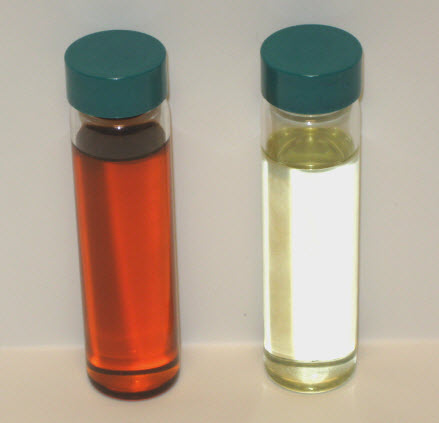
Biodiesel Distillation
Left – Finished Biodiesel
Right – Distilled Biodiesel
Both samples came from the same batch
Also check out, “Biodiesel Industry“