
Spinning Cone Distillation Column
Spinning Cone Distillation Column
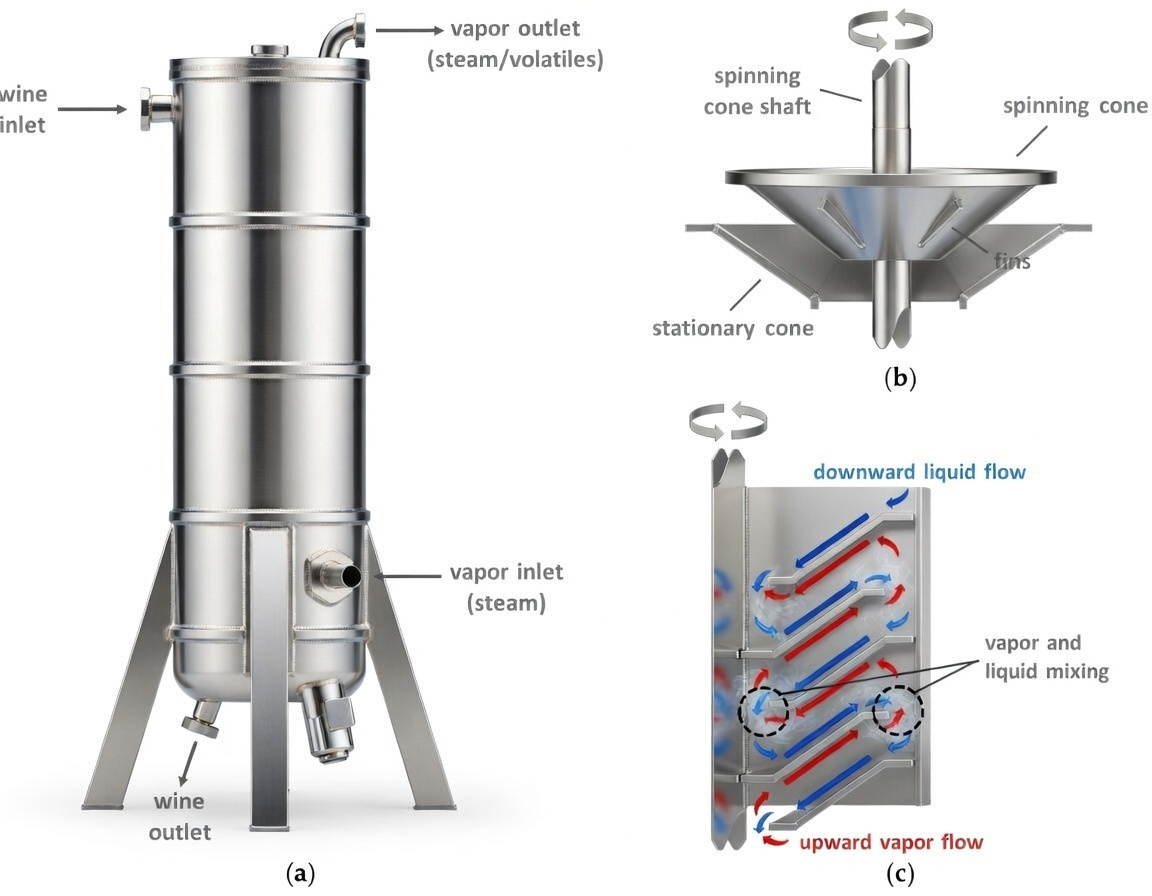
Engineers design the spinning cone distillation column as a vertical stainless-steel tower. This tower separates heat-sensitive liquids with exceptional precision. Operators feed the liquid at the top. Meanwhile, steam rises from the bottom. A central shaft rotates rapidly inside the column. It drives inverted cones that spin at high speed. Stationary cones, fixed to the inner wall, interlock with the spinning ones. As a result, they create a zigzag path for liquid and vapor. Manufacturers build the column for continuous flow. Therefore, it becomes ideal for delicate products that traditional distillation would damage. In addition, the system preserves aromas, flavors, and volatile compounds that heat would otherwise destroy. Developed in Australia during the 1980s, winemakers first adopted it to reduce alcohol without losing character. Today, it transforms beverages, essential oils, and other sensitive liquids worldwide.
Structure and Core Components
Technicians assemble the column from polished stainless steel. This material resists corrosion and ensures sanitary operation. The tower stands several meters tall, yet it occupies minimal floor space. A robust motor drives the central shaft at speeds between 300 and 600 revolutions per minute. Engineers craft the spinning cones from perforated steel. They invert these cones to direct liquid outward. Each cone measures less than a meter in diameter and tapers sharply. Workers weld stationary cones to the column wall in precise positions. These fixed cones catch liquid from above. Then they guide it to the next spinning cone. As a result, the design forces liquid to travel downward in thin films. In addition, steam enters through nozzles at the base and flows upward in counter-current fashion. Consequently, vapor exits through a port at the top while residue leaves from the bottom outlet.
Liquid Introduction and Initial Distribution
Operators pump the feed liquid to the top inlet where gravity begins its descent. The liquid splashes onto the uppermost spinning cone and immediately encounters centrifugal force. Rotation flings the liquid outward in a uniform sheet that coats the cone surface. Perforations allow excess liquid to drain while the film remains thin. This initial film exposes maximum surface area to the rising steam. Turbulence from the spinning motion enhances contact between phases. The liquid then cascades onto the first stationary cone where it spreads again before dropping to the next spinning cone. Each transfer renews the film and prevents channeling. The process repeats through the entire stack of cones.
Steam Flow and Counter-Current Contact
Technicians inject superheated steam at the column base through a distribution ring. Consequently, the steam rises evenly through the annular spaces between cones. As steam meets descending liquid films, volatile components transfer into the vapor phase. In addition, heat from the steam vaporizes light molecules without overheating the bulk liquid. Moreover, the counter-current flow maintains a concentration gradient. This gradient drives separation effectively. For example, steam strips alcohol from wine or aromas from coffee extract with equal ease. Furthermore, condensation of steam adds gentle heating. Therefore, it avoids hot spots. Finally, the system operates under slight vacuum when processing extremely delicate materials.
Mass Transfer in Thin Films
Centrifugal force generates films thinner than one millimeter across each spinning cone. This extreme thinness multiplies surface area available for mass transfer. Steam bubbles scrub the film surface and carry away volatiles in a continuous stripping action. Each cone pair acts as a theoretical separation stage. The zigzag path ensures liquid contacts fresh steam repeatedly. Turbulence prevents equilibrium and maintains driving force. Volatiles concentrate in the vapor stream while heavy components remain in the liquid. The process achieves separation efficiencies that packed columns require far greater height to match.
Vapor Collection and Condensation
Vapors exit the top of the column carrying concentrated volatiles and steam. Operators direct this stream to a condenser where cooling water collapses the vapor. The condensate separates into organic and aqueous phases if needed. Rectifiers refine the distillate to recover pure alcohol or aroma compounds. Winemakers capture delicate esters that define varietal character. Perfumers isolate top notes that fade in traditional stills. The system recovers over ninety percent of target volatiles in a single pass. Quality remains pristine because residence time stays under thirty seconds.
Residue Removal and Product Handling
Dealcoholized liquid reaches the bottom cone and flows into a collection chamber. Pumps remove the residue continuously to prevent buildup. The output contains concentrated flavors minus removed volatiles. Juice producers achieve higher Brix levels without cooking the product. Brewers obtain non-alcoholic beer bases that retain malt character. The gentle process preserves heat-labile vitamins and antioxidants. Operators adjust steam rate to control final concentration precisely.
Operational Control and Automation
Sensors monitor temperature, pressure, flow rates, and rotation speed throughout the column. Computers adjust motor speed and steam valves in real time. Touch screens display process parameters and allow setpoint changes. Automated startup sequences prevent thermal shock to delicate feeds. Safety interlocks shut down the system if parameters drift outside limits. Remote monitoring enables oversight from control rooms or mobile devices. The system maintains consistent output hour after hour.
Cleaning and Maintenance Procedures
Clean-in-place systems circulate detergent through spray balls at column top and bottom. Hot water rinses follow to remove all residue. Stationary cones feature smooth surfaces that resist fouling. Spinning cones detach easily for inspection or replacement. Bearings receive lubrication automatically during operation. Maintenance crews perform full teardown annually or after major product changes. The sanitary design meets food and pharmaceutical standards without exception.
Applications in Wine and Beverage Production
Winemakers feed fermented wine into the column to reduce alcohol content selectively. The process removes ethanol while retaining volatile esters and phenolics. Resulting wines below 0.5% alcohol taste balanced and complex. Consumers seeking lower-calorie options embrace these products. Producers adjust dealcoholization degree by varying steam input. The column processes red, white, and sparkling bases equally well.
Brewers produce non-alcoholic beer that rivals traditional versions in flavor. The column strips alcohol after fermentation preserves hop oils and malt character. Soft drink manufacturers concentrate fruit juices to reduce shipping weight. Coffee processors recover aroma compounds before spray drying. Tea extractors capture delicate top notes from green leaves. Each application benefits from gentle thermal profile and continuous operation.
Essential Oil and Fragrance Extraction
Botanical processors feed steam-distilled hydrosols into the column to separate oils. The system concentrates terpenes and sesquiterpenes without degradation. Perfumers obtain true-to-nature isolates for fine fragrance creation. Citrus oil producers recover cold-pressed character that heat would alter. Rose otto maintains its precious damascone profile. The column handles small batches or continuous production seamlessly.
Pharmaceutical and Nutraceutical Uses
Drug manufacturers isolate heat-sensitive actives from plant extracts. The short residence time protects molecular integrity. Nutraceutical producers concentrate omega-three oils without oxidation. Herbal extractors remove solvents from tinctures under vacuum. Each process validates easily for regulatory compliance. Yields exceed batch distillation by significant margins.
Energy and Environmental Benefits
The column operates with minimal pressure drop across its height. Steam usage optimizes through efficient heat transfer. Motors consume modest power compared to separation achieved. Condensate returns to boilers after heat exchange. Water recycling reduces fresh makeup needs. Carbon footprint shrinks versus traditional distillation methods. Plants meet sustainability goals while maintaining profitability.
Future Developments and Innovations
Researchers develop micro-textured cone surfaces to enhance turbulence further. Engineers integrate inline analytics for real-time composition control. Designers explore ceramic cones for aggressive chemical service. Software engineers create predictive maintenance algorithms. The technology evolves continuously to meet emerging needs. New applications emerge as industries discover its gentle power.
Conclusion
The spinning cone distillation column revolutionizes separation of delicate liquids through elegant engineering and precise control. It delivers superior results where traditional methods fail. Industries worldwide adopt this technology to create better products with less waste. The column stands as a testament to innovative distillation design.

Also check out,” Spinning Cone How it Works“