
- Home
- Technologies
- Filtration
- Distillation Columns
- Evaporators
- Liquid to Liquid Extraction
- Centrifuges
- Blending Technology
- Industries
- Services
- Projects
- News
- About SRS
- Contact Us
Decanter Centrifuges
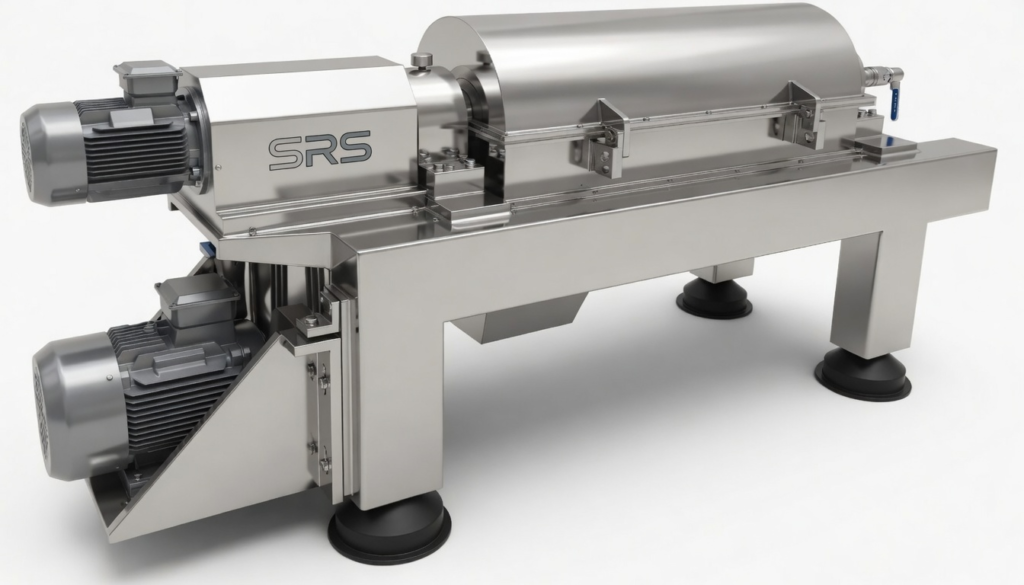
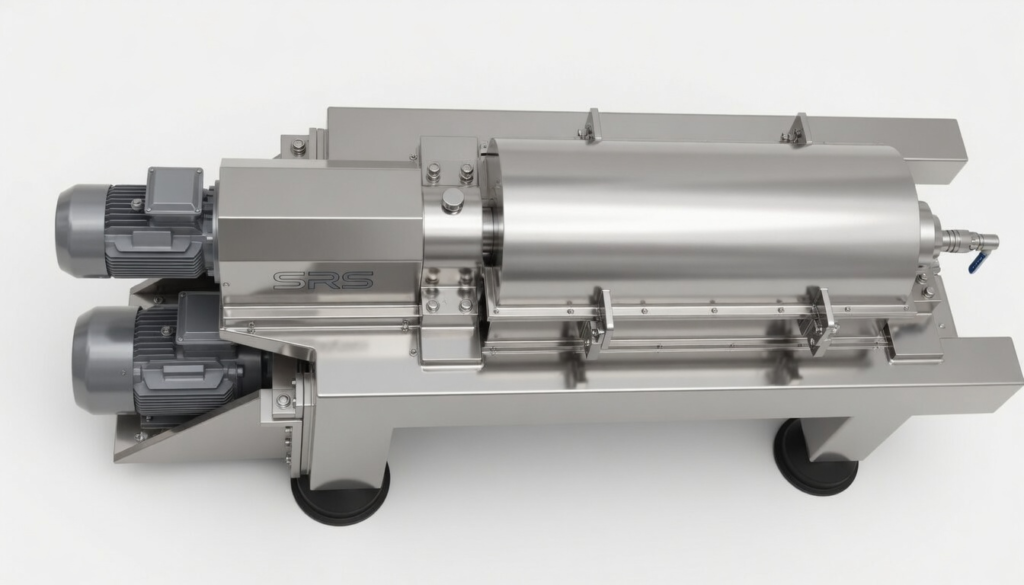
Decanter Centrifuge
Continuous High-Solids Solid-Liquid Separation Technology
A Decanter Centrifuge is a horizontal, scroll-type centrifuge designed for continuous, high-volume solid-liquid separation. It is one of the most robust and versatile separation machines in industrial processing, capable of handling feeds with high solids content (up to 60%).
How a Decanter Centrifuge Works
The slurry enters the rotating bowl through a central feed pipe. Centrifugal force (2,000 – 4,500 g) pushes heavier solids to the bowl wall. A rotating scroll conveyor moves the settled solids toward the conical end for discharge, while the clarified liquid overflows from the opposite end. This enables fully continuous operation.
Advantages & Limitations
| Advantages | Limitations |
|---|---|
| • Fully continuous operation • Handles high solids content • Robust and reliable for tough slurries • Good cake dryness • High throughput capacity | • Lower G-force than bowl centrifuges • Higher wear on scroll and bowl • Requires regular maintenance • Less effective for very fine particles |
Decanter Centrifuge – Technical Specifications
High-Solids Continuous Separation System
Decanter Centrifuges are robust, horizontal scroll-type machines designed for continuous solid-liquid separation of high-solid content slurries. They are widely used for dewatering, classification, and clarification across multiple industries.
Technical Specifications
| Parameter | Typical Range | Standard / High-Performance |
|---|---|---|
| Centrifugal Force | 1,500 – 4,500 g | 3,000 – 4,500 g |
| Bowl Speed | 2,000 – 5,500 RPM | 3,000 – 4,500 RPM |
| Bowl Diameter | 200 – 1,400 mm | 350 – 800 mm |
| Processing Capacity | 1 – 150 m³/h | 5 – 80 m³/h |
| Solids Content (Feed) | 5% – 60% | 10% – 50% |
| Cake Dryness | 20% – 40% DS | 28% – 38% DS |
| Material of Construction | Stainless Steel 316L, Duplex, Super Duplex | Duplex / Super Duplex with tungsten carbide protection |
Key Design Features
| Feature | Description |
|---|---|
| Scroll Design | Double-lead or triple-lead scroll with tungsten carbide tiles for wear protection |
| Differential Speed | Adjustable via gearbox or VFD (1 – 50 rpm differential) |
| pond Depth | Adjustable weir plates for optimal pond depth control |
| 2-Phase / 3-Phase | Available in both 2-phase (solid-liquid) and 3-phase (solid-liquid-liquid) configurations |
Decanter Centrifuges are engineered for reliable, continuous operation in demanding high-solids applications, delivering consistent performance with minimal operator intervention.
Decanter Centrifuge Efficiency Chart
Performance Comparison for High-Solids Separation
Decanter Centrifuges are designed for continuous, high-throughput dewatering of slurries with high solids content. Below is a detailed efficiency comparison.
| Parameter | Filter Press | Belt Press | Bowl Centrifuge | Decanter Centrifuge |
|---|---|---|---|---|
| Typical Solids Content | 10 – 40% | 5 – 25% | < 5% | 10 – 60% |
| Centrifugal Force | — | — | 8,000 – 15,000 g | 2,000 – 4,500 g |
| Cake Dryness | 30 – 45% | 20 – 35% | N/A (low solids) | 25 – 40% |
| Operation Mode | Batch | Continuous | Batch / Semi | Fully Continuous |
| Throughput Capacity | Medium | High | Medium | Very High |
| Energy Consumption | Medium | Low | High | Medium |
| Best For | High solids dewatering | Large volume sludge | Clarification | Continuous high-solids separation |
Conclusion: Decanter Centrifuges provide the best balance of continuous operation, high throughput, and good cake dryness for medium to high solids slurries.
Decanter Centrifuge – Frequently Asked Questions
Common Questions Answered
| Question | Answer |
|---|---|
| What is a Decanter Centrifuge? | A Decanter Centrifuge is a horizontal, continuous solid-liquid separation machine that uses high centrifugal force and a rotating scroll to separate solids from liquids, especially effective for high-solid slurries. |
| How does a Decanter Centrifuge differ from a Bowl Centrifuge? | Decanters are designed for continuous operation with high solids content, while Bowl Centrifuges are used for high-clarity polishing of low-solid liquids with much higher G-forces. |
| What is the typical G-force of a Decanter? | Decanters usually operate between 2,000 – 4,500 g, significantly lower than bowl centrifuges but sufficient for heavy dewatering. |
| What industries use Decanter Centrifuges? | Wastewater treatment, biodiesel (glycerol separation), edible oil processing, mining, chemical sludge dewatering, and food industry (fruit juice, starch, etc.). |
| Can Decanters handle high solids content? | Yes, they are excellent for feeds with 10% to 60% solids and can produce dry cake discharge continuously. |
| What is the difference between 2-phase and 3-phase Decanters? | 2-phase separates solids from liquid. 3-phase separates solids, heavy liquid, and light liquid (e.g., oil-water-solids separation). |
| What maintenance is typically required? | Regular scroll and bowl wear inspection, gearbox oil changes, bearing lubrication, and conveyor alignment checks. |
Decanter Centrifuge Applications
High-Solids Continuous Separation Solutions
Decanter Centrifuges are ideal for continuous dewatering and solid-liquid separation of high-solid content slurries. They excel where large volumes and consistent cake dryness are required.
| Industry | Key Applications | Benefits |
|---|---|---|
| Wastewater Treatment | Municipal sludge dewatering, industrial effluent treatment, digester sludge | High cake dryness, reduced disposal costs |
| Biodiesel & Renewable Fuels | Glycerin separation, soapstock splitting, catalyst recovery | Continuous operation, high purity phases |
| Food & Beverage | Fruit juice pulp separation, starch dewatering, beer yeast recovery, olive oil extraction | High throughput and gentle processing |
| Mining & Minerals | Tailings dewatering, mineral classification, coal fines recovery | Robust handling of abrasive slurries |
| Chemical & Petrochemical | Polymer dewatering, catalyst separation, crystalline product recovery | Continuous reliable operation |
| Edible Oil Processing | Degumming, soapstock splitting, winterization | Efficient solids removal from oils |
Decanter Centrifuges are the preferred choice for continuous, high-volume solid-liquid separation where robust performance and consistent cake dryness are required.
Decanter Centrifuge – Advantages & Disadvantages
Balanced Evaluation of Decanter Technology
| Advantages | Disadvantages |
|---|---|
| • Fully continuous operation with high throughput • Excellent for high-solids slurries (10–60% solids) • Good cake dryness and clear centrate • Robust design handles abrasive materials • Lower energy consumption per ton of solids • Minimal operator intervention required • Versatile for 2-phase and 3-phase separation | • Lower G-force than bowl centrifuges (less effective for very fine particles) • Higher wear on scroll and bowl due to abrasion • Requires regular maintenance of gearbox and bearings • Larger footprint compared to bowl centrifuges • Sensitive to feed variations (flow rate & solids content) • Higher initial capital cost for large units |
Decanter Centrifuges are the best choice for continuous, high-volume solid-liquid separation where robust performance and reliable cake discharge are more important than ultra-fine clarification.