
- Home
- Technologies
- Filtration
- Distillation Columns
- Evaporators
- Liquid to Liquid Extraction
- Centrifuges
- Blending Technology
- Industries
- Services
- Projects
- News
- About SRS
- Contact Us
Thin Film Evaporators
High-Efficiency Evaporation for Heat-Sensitive Products
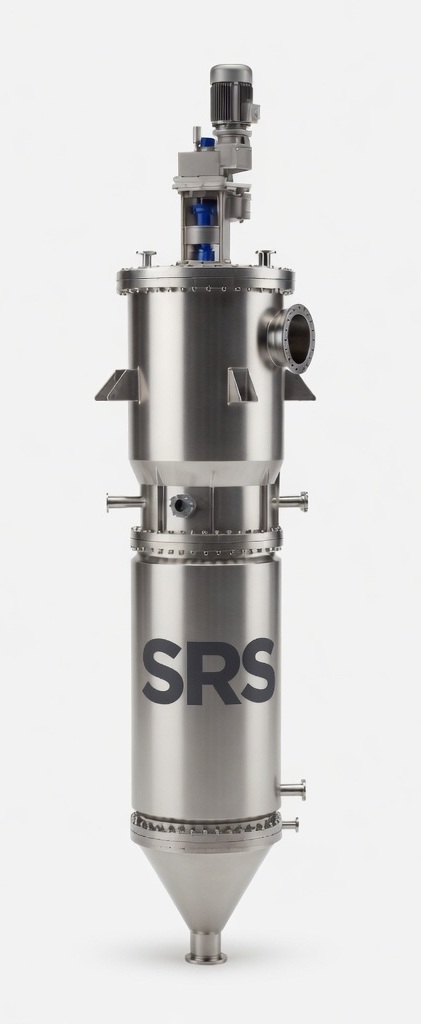
Thin Film Evaporators are advanced thermal separation systems designed to evaporate and concentrate heat-sensitive, viscous, or high-boiling products under gentle conditions. They create a thin film of liquid on a heated surface, allowing rapid evaporation with very short residence time.
How Thin Film Evaporators Work
The feed is distributed evenly on the inner wall of a heated cylindrical shell. A rotating rotor or gravity forms a thin turbulent film. This dramatically increases heat transfer and allows evaporation at lower temperatures under vacuum, minimizing thermal degradation.
Advantages & Limitations
| Advantages | Limitations |
|---|---|
| • Extremely short residence time • Handles viscous and heat-sensitive products • High heat transfer coefficients • Minimal thermal degradation • Excellent for concentration and solvent recovery | • Higher capital cost • Requires precise feed distribution • Limited to moderate solids content • Complex mechanical design (especially wiped film) |
Technical Specifications
| Parameter | Typical Range |
|---|---|
| Operating Temperature | 40 – 250°C (very low for sensitive products) |
| Operating Pressure | Vacuum (1 – 100 mbar) |
| Residence Time | 5 – 60 seconds |
| Film Thickness | 0.1 – 1.0 mm |
| Evaporation Rate | Up to 90% in a single pass |
Thin Film Evaporator Efficiency Chart
Performance Comparison with Conventional Evaporators
Thin Film Evaporators excel in handling heat-sensitive and viscous products with very short residence times and high heat transfer efficiency.
| Parameter | Falling Film Evaporator | Forced Circulation Evaporator | Thin Film Evaporator |
|---|---|---|---|
| Residence Time | 20 – 60 seconds | 1 – 5 minutes | 5 – 30 seconds |
| Heat Sensitivity | Good | Moderate | Excellent |
| Viscosity Handling | Low to Medium | High | Very High |
| Energy Efficiency | High | Medium | Very High |
| Fouling Tendency | Medium | Low | Very Low |
| Concentration Ratio | High | Very High | Highest (Single Pass) |
| Best For | Low viscosity | Crystallizing products | Heat-sensitive & viscous products |
Conclusion: Thin Film Evaporators provide the shortest residence time and lowest thermal stress, making them the superior choice for heat-sensitive and viscous materials.
Thin Film Evaporator – Advantages & Disadvantages
Balanced Evaluation of Thin Film Evaporation Technology
| Advantages | Disadvantages |
|---|---|
| • Very short residence time (seconds) • Excellent for heat-sensitive products • Handles high-viscosity fluids effectively • High heat transfer coefficients • Low thermal degradation and fouling • High concentration ratios in single pass • Continuous operation with minimal hold-up | • Higher capital cost compared to conventional evaporators • Complex mechanical design (rotor & wiper system) • Requires skilled maintenance • Limited to moderate throughput capacities • Higher energy consumption per kg of evaporation in some cases • Sensitive to solid particles in feed |
Thin Film Evaporators are the preferred choice when product quality and thermal sensitivity are the top priorities, despite their higher initial investment.
Thin Film Evaporator Applications
High-Efficiency Evaporation for Heat-Sensitive Products
Thin Film Evaporators are ideal for concentrating, separating, and purifying heat-sensitive, viscous, or high-boiling materials under vacuum with very short residence times.
| Industry | Key Applications | Benefits |
|---|---|---|
| Pharmaceuticals | API concentration, solvent recovery, vitamin and antibiotic purification | Gentle processing, minimal thermal degradation |
| Food & Beverage | Fruit juice concentration, milk products, flavor & aroma recovery | Preserves taste, color, and nutritional value |
| Essential Oils & Fragrances | Concentration and purification of natural extracts | Retains volatile and heat-sensitive compounds |
| Polymers & Resins | Polymer devolatilization, monomer stripping, resin concentration | High viscosity handling, low residence time |
| Chemicals & Petrochemicals | Solvent recovery, high-boiling point purification, viscous fluid concentration | Energy efficient, handles fouling products |
| Wastewater & Environmental | Zero Liquid Discharge (ZLD), effluent concentration | High concentration ratios, reduced waste volume |
Thin Film Evaporators are the preferred technology whenever short residence time, low thermal stress, and high product quality are critical requirements.
Thin Film Evaporator – Frequently Asked Questions
Common Questions Answered
| Question | Answer |
|---|---|
| What is a Thin Film Evaporator? | A Thin Film Evaporator is a high-efficiency evaporator that spreads the product into a thin film on a heated surface using a rotating wiper system, allowing very short residence times and gentle evaporation of heat-sensitive materials. |
| What are the main advantages of Thin Film Evaporators? | Extremely short residence time (seconds), excellent for viscous and heat-sensitive products, high heat transfer rates, and ability to achieve high concentration ratios in a single pass. |
| What products are best suited for Thin Film Evaporators? | Heat-sensitive materials like pharmaceuticals, essential oils, polymers, fruit juices, vitamins, and high-viscosity chemicals. |
| What is the difference between Falling Film and Thin Film Evaporators? | Falling Film relies on gravity flow, while Thin Film uses mechanical wipers to create and renew the thin film, making it better for viscous and fouling products. |
| Can Thin Film Evaporators handle solids? | They can handle moderate solids but are best for solutions or slurries with low to medium solid content. High solids may require pre-filtration. |
| What is the typical operating pressure? | Usually under vacuum (10 – 100 mbar) to reduce boiling temperatures and protect heat-sensitive products. |
| How energy efficient are Thin Film Evaporators? | They are highly efficient due to excellent heat transfer and short residence time, often outperforming conventional evaporators for viscous products. |