
- Home
- Technologies
- Filtration
- Distillation Columns
- Evaporators
- Liquid to Liquid Extraction
- Centrifuges
- Blending Technology
- Industries
- Services
- Projects
- News
- About SRS
- Contact Us
Vacuum Distillation Columns
Vacuum Distillation Column
Low-Pressure Distillation for Heat-Sensitive Products
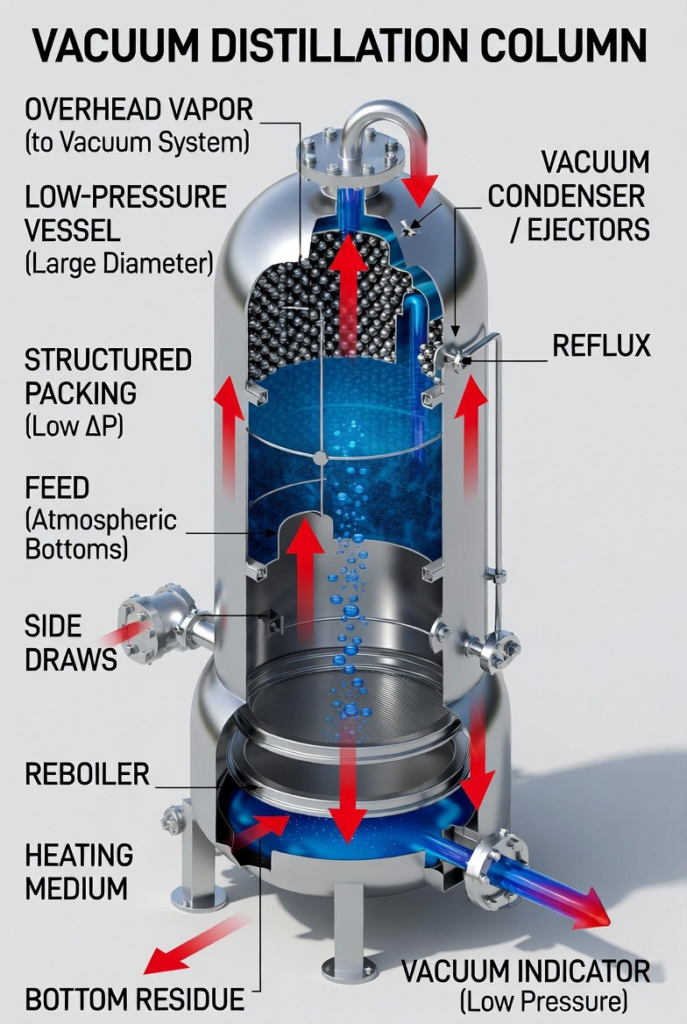
Vacuum Distillation Columns operate under reduced pressure to lower the boiling points of components. This allows gentle separation of high-boiling, heat-sensitive, or thermally unstable materials without decomposition or degradation.
How Vacuum Distillation Works
By lowering the system pressure (typically 10–200 mbar), the boiling temperature of the mixture decreases significantly. This enables distillation at much lower temperatures, protecting sensitive products like edible oils, polymers, and pharmaceuticals.
Vacuum Distillation Column Specifications
Technical Design & Performance Data
Vacuum Distillation Columns are engineered for gentle separation of heat-sensitive and high-boiling materials under reduced pressure, preventing thermal decomposition while achieving high purity and yield.
General Technical Specifications
| Parameter | Typical Range | Standard Design |
|---|---|---|
| Operating Pressure | 10 – 200 mbar (absolute) | 20 – 100 mbar |
| Operating Temperature | 80 – 260°C | 120 – 220°C |
| Column Diameter | 1.0 – 8.0 meters | 2.0 – 5.5 meters |
| Column Height | 15 – 65 meters | 25 – 50 meters |
| Internals | Structured packing (preferred), high-efficiency trays | High-performance structured packing |
Key Design Features
| Feature | Description |
|---|---|
| Vacuum System | Multi-stage steam ejectors, liquid ring vacuum pumps, or dry screw pumps |
| Pressure Drop | Very low pressure drop internals (structured packing) |
| Material of Construction | Stainless Steel 316L, Duplex, or exotic alloys for corrosion resistance |
| Heat Management | Optimized reboilers and condensers with minimal thermal stress |
| Applications | Edible oil deodorization, heavy petroleum fractions, polymers, essential oils |
Vacuum Distillation Efficiency Chart
Performance Benefits vs Atmospheric Distillation
| Parameter | Atmospheric Distillation | Vacuum Distillation | Improvement |
|---|---|---|---|
| Operating Temperature | 280 – 400°C | 120 – 250°C | Significant Reduction |
| Thermal Degradation | High | Very Low | Excellent Protection |
| Product Quality | Lower | Superior | Much Higher Purity & Color |
| Energy Efficiency | Baseline | Better for heavy fractions | 15 – 35% Savings |
| Yield Recovery | 75 – 85% | 88 – 96% | +8 – 15% |
| Best For | Stable, low-boiling mixtures | Heat-sensitive & heavy materials | Edible oils, polymers, heavy oils |
Key Advantage: Vacuum Distillation allows gentle processing of heat-sensitive materials while delivering superior product quality and higher yields.
Vacuum Distillation Column Applications
Gentle Separation for Heat-Sensitive & High-Boiling Materials
Vacuum Distillation Columns are essential when processing materials that would degrade or polymerize at atmospheric boiling temperatures.
| Industry | Key Applications | Benefits |
|---|---|---|
| Edible Oils & Fats | Deodorization, deacidification, tocopherol recovery, winterization | Preserves natural antioxidants, maintains light color and neutral taste |
| Petroleum Refining | Vacuum gas oil (VGO), lubricating oil base stocks, bitumen production | Prevents cracking of heavy fractions |
| Essential Oils & Fragrances | Extraction and purification of natural essential oils | Retains delicate aromatic compounds |
| Polymers & Resins | Monomer recovery, polymer devolatilization | Minimizes thermal degradation |
| Pharmaceuticals | API purification, solvent recovery, vitamin & nutraceutical concentration | Maintains product stability and potency |
| Fine Chemicals | High-boiling solvent recovery, specialty chemical purification | High purity with minimal by-products |
Vacuum Distillation is the preferred technology whenever product quality and thermal stability are critical.
Vacuum Distillation Column – Advantages & Disadvantages
Balanced Evaluation of Vacuum Distillation Technology
| Advantages | Disadvantages |
|---|---|
| • Excellent for heat-sensitive materials (prevents thermal cracking & degradation) • Higher product quality and lighter color • Improved yield of valuable fractions • Lower operating temperatures reduce energy use for heavy oils • Widely proven in edible oil and petroleum industries • Preserves natural compounds and antioxidants | • Requires large and sophisticated vacuum systems • Higher capital investment for vacuum equipment and seals • Larger column diameters due to low vapor density • More complex operation and maintenance • Risk of air leakage affecting vacuum and product quality • Higher sensitivity to pressure fluctuations |
Vacuum Distillation is the preferred technology when processing high-boiling or heat-sensitive materials where product quality and thermal stability are critical priorities.
Vacuum Distillation Column – Frequently Asked Questions
Common Questions Answered
| Question | Answer |
|---|---|
| What is a Vacuum Distillation Column? | A Vacuum Distillation Column operates under reduced pressure (typically 10–200 mbar) to lower boiling points, allowing gentle separation of heat-sensitive or high-boiling materials without thermal degradation. |
| Why is vacuum used in distillation? | Lower pressure reduces the boiling temperature, preventing decomposition, polymerization, or color formation in sensitive products like edible oils and pharmaceuticals. |
| What are the main applications? | Edible oil deodorization, petroleum residue processing, essential oil extraction, polymer devolatilization, and pharmaceutical purification. |
| What pressure range is typically used? | Most industrial vacuum distillation operates between 10 – 100 mbar, depending on the product sensitivity. |
| What type of internals are preferred? | Structured packing is preferred because it offers very low pressure drop, which is critical under vacuum conditions. |
| What are the main challenges? | Maintaining a deep and stable vacuum, preventing air leaks, and managing large vacuum systems. |
| How does it compare to atmospheric distillation? | Vacuum distillation allows much lower temperatures, resulting in better product quality and higher yields for heat-sensitive materials. |