
- Home
- Technologies
- Filtration
- Distillation Columns
- Evaporators
- Liquid to Liquid Extraction
- Centrifuges
- Blending Technology
- Industries
- Services
- Projects
- News
- About SRS
- Contact Us
Pressure leaf Filtration
High-Efficiency Pressure Filtration Technology
Pressure Leaf Filtration is a highly efficient, batch-operated filtration system used for solid-liquid separation in industries requiring high clarity, high throughput, and reliable cake discharge. It consists of a pressure vessel containing multiple vertical or horizontal filter leaves covered with filter cloth or wire mesh.
Vertical vs Horizontal Pressure Leaf Filters
| Parameter | Vertical Pressure Leaf Filter | Horizontal Pressure Leaf Filter |
|---|---|---|
| Orientation | Vertical leaves, vertical vessel | Horizontal leaves, horizontal vessel |
| Cake Discharge | Gravity + vibration / sluicing | Excellent self-discharge by rotating leaves |
| Filtration Area | Medium to Large | Large to Very Large |
| Cleaning Method | Backwashing or manual | Automatic rotating spray nozzles |
| Best For | Fine filtration, polishing, smaller batches | Large volume, heavy cake, frequent cleaning |
| Typical Industries | Edible oils, chemicals, pharmaceuticals | Sugar, starch, chemicals, wastewater |
Pressure Leaf Filters offer dry cake discharge, high filtration rates, and fully enclosed operation, making them safer and cleaner than open filtration systems.
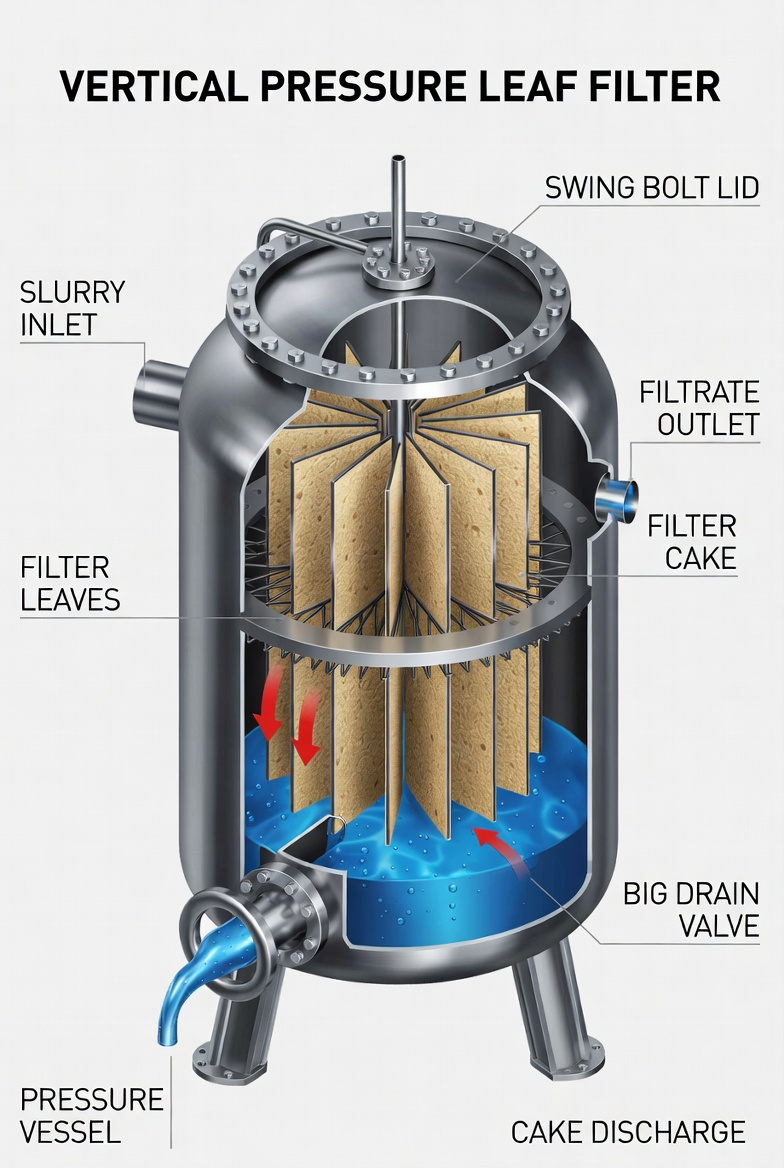
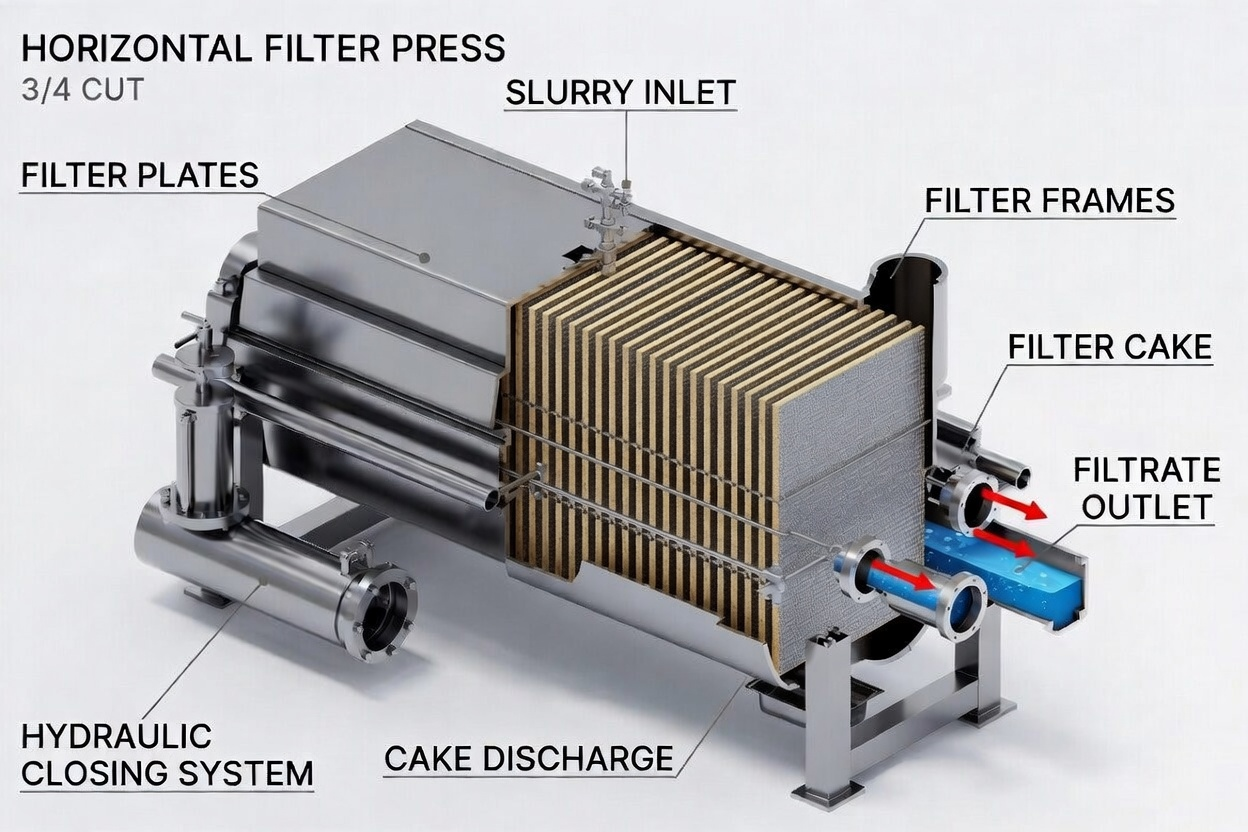
Pressure Leaf Filter – Technical Specifications
Vertical & Horizontal Pressure Leaf Filters
| Parameter | Vertical Pressure Leaf Filter | Horizontal Pressure Leaf Filter |
|---|---|---|
| Filtration Area | 5 – 200 m² | 10 – 500 m² |
| Design Pressure | Up to 10 bar (g) | Up to 10 bar (g) |
| Design Temperature | Up to 150°C | Up to 150°C |
| Leaf Spacing | 50 – 100 mm | 70 – 120 mm |
| Cake Thickness (Max) | 25 – 50 mm | 40 – 80 mm |
| Cake Discharge | Vibration + Gravity | Automatic rotating sluice / scraper |
| Filtration Media | Stainless steel mesh, synthetic cloth | Stainless steel mesh, synthetic cloth |
| Typical Flow Rate | 0.5 – 4 m³/m²/h | 0.8 – 5 m³/m²/h |
Both Vertical and Horizontal Pressure Leaf Filters are fully enclosed, pressure-rated systems that deliver high filtration rates with dry cake discharge and minimal product loss.
Typical Filtration Cycle
Pressure Leaf Filter Operation Sequence
A complete filtration cycle in a Pressure Leaf Filter is a batch process that typically lasts 4 to 12 hours, depending on the product and solids loading. The cycle is fully automated in modern systems.
| Stage | Process Description | Duration (Typical) |
|---|---|---|
| Precoating | Filter aid (e.g., diatomaceous earth) is circulated to form a uniform precoat layer on the leaves for better clarity and easier cake release. | 10 – 30 minutes |
| Filling & Feeding | The filter is filled with slurry under pressure. Solids begin to build a cake on the filter leaves. | 15 – 45 minutes |
| Filtration / Cake Building | Main filtration phase where slurry is continuously fed and clear filtrate is collected. Cake thickness increases. | 2 – 8 hours |
| Cake Washing (Optional) | Displacement washing with clean solvent or water to remove impurities from the cake. | 20 – 60 minutes |
| Air Drying / Blowdown | Compressed air is used to remove remaining liquid from the cake, producing a drier cake. | 10 – 30 minutes |
| Cake Discharge | Cake is discharged by vibration (vertical) or by rotating the leaves and sluicing (horizontal). | 5 – 15 minutes |
| Cleaning & Reset | Internal spray cleaning of leaves and vessel before starting the next cycle. | 10 – 20 minutes |
The entire cycle is highly automated in modern systems, ensuring consistent performance, dry cake discharge, and minimal downtime.
Cake Discharge Methods
Pressure Leaf Filter Cake Removal Techniques
Cake discharge is a critical step in the pressure leaf filtration cycle. The method used significantly affects cycle time, cake dryness, labor requirements, and overall efficiency. Different designs use different techniques for effective cake removal.
| Discharge Method | Description | Best Suited For |
|---|---|---|
| Vibration Discharge | Mechanical vibration of the filter leaves or vessel to dislodge the cake, which then falls by gravity. | Vertical leaf filters with dry, friable cakes |
| Sluicing / Water Spray | High-pressure water or process liquid sprays to wash the cake off the leaves. | Sticky or wet cakes, vertical and horizontal filters |
| Pneumatic / Air Blow | Compressed air or gas is blown from inside the leaves to detach and dry the cake. | Dry cake applications requiring minimal moisture |
| Rotating Leaf Discharge | Horizontal leaves rotate while scraper blades or centrifugal force remove the cake. | Horizontal pressure leaf filters with heavy cake loads |
The choice of cake discharge method depends on cake characteristics (stickiness, moisture, thickness), filter design (vertical or horizontal), and desired cycle time. Modern systems often combine multiple methods for optimal performance and minimal downtime.
Pressure Leaf Filter – Advantages & Disadvantages
Balanced Evaluation of Pressure Leaf Filtration
| Advantages | Disadvantages |
|---|---|
| • Fully enclosed system – safe and clean operation • High filtration rates and excellent cake dryness • Low labor requirement with automatic discharge • Consistent and repeatable filtration cycles • Suitable for hazardous and volatile liquids • Long filter cloth / mesh life • Can handle high temperatures and pressures | • Batch operation (not continuous) • High initial capital cost • Requires skilled maintenance for leaf integrity • Cake discharge can be difficult with sticky products • Limited to moderate solid loading per cycle • Downtime during cake discharge and cleaning |
Pressure Leaf Filters are ideal for applications requiring high product purity, safety, and reliable cake discharge in batch processes.
Pressure Leaf Filter – Frequently Asked Questions
Common Questions Answered
| Question | Answer |
|---|---|
| What is a Pressure Leaf Filter? | A Pressure Leaf Filter is a batch-operated, pressure vessel system containing multiple filter leaves used for solid-liquid separation. It is known for high clarity filtrate and dry cake discharge. |
| What is the difference between Vertical and Horizontal Pressure Leaf Filters? | Vertical filters discharge cake by vibration/gravity. Horizontal filters use rotating leaves and spray nozzles for automatic, more efficient cake discharge. |
| What industries use Pressure Leaf Filters? | Edible oils, sugar refining, chemicals, pharmaceuticals, starch, and wastewater treatment. |
| How long does a typical filtration cycle take? | A complete cycle usually takes 4 to 12 hours, depending on solids loading, viscosity, and desired cake thickness. |
| What is pre-coating and why is it used? | Pre-coating applies a layer of filter aid (like diatomaceous earth) on the leaves to improve filtrate clarity and help with cake release. |
| Can Pressure Leaf Filters handle corrosive liquids? | Yes, they can be built with stainless steel, duplex, or exotic alloys to handle corrosive and high-temperature applications. |
| What are the main advantages of Pressure Leaf Filters? | Enclosed operation, high filtration rates, dry cake discharge, low labor requirement, and suitability for hazardous liquids. |
Pressure Leaf Filter Applications
Proven Performance Across Industries
Pressure Leaf Filters are ideal for batch filtration processes requiring high clarity, dry cake discharge, and safe enclosed operation.
| Industry | Key Applications | Benefits |
|---|---|---|
| Edible Oils & Fats | Bleaching earth removal, winterization, dewaxing, final polishing | Crystal clear oil, extended shelf life |
| Sugar & Starch | Carbon removal, juice clarification, starch washing | High throughput and excellent filtrate clarity |
| Chemicals & Petrochemicals | Catalyst recovery, fine chemical polishing, resin filtration | Safe handling of hazardous liquids |
| Pharmaceuticals | API purification, activated carbon removal, sterile filtration | High purity and sanitary operation |
| Wastewater Treatment | Heavy metal removal, sludge thickening, process water recovery | Dry cake for easy disposal |
Pressure Leaf Filters are especially valued where product quality, safety, and efficient cake handling are critical requirements.