
Plate Evaporator
Plate Evaporators
Plate evaporators are compact, highly efficient thermal separators that concentrate solutions using plate heat exchangers instead of traditional tube bundles. The feed liquid flows through channels between plates while heating medium (steam or hot water) flows in alternating channels, causing rapid evaporation. Plate evaporators offer superior heat transfer, small footprint, low hold-up volume, and easy maintenance — making them ideal for heat-sensitive, viscous, or fouling-prone products in food, dairy, pharmaceuticals, chemicals, and wastewater applications.
System Design & Key Components
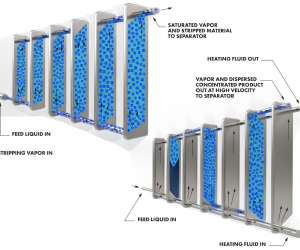
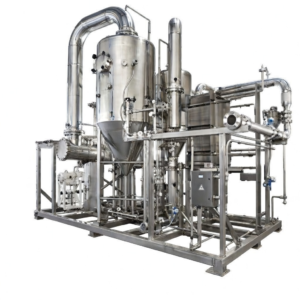
Plate evaporators use gasketed or welded plate packs (typically stainless steel) arranged in a frame. Key components include:
- Plate pack with alternating product and heating channels
- Product inlet/outlet nozzles and distribution system
- Heating medium inlet/outlet (steam/hot water)
- Vapor-liquid separator (cyclone or baffle type)
- Condenser and vacuum system
- Frame with tightening bolts for easy disassembly
Signature feature: Extremely high heat transfer coefficients (up to 4,000–6,000 W/m²·K) due to corrugated plates and high turbulence.
Plate Evaporation Process
The continuous process follows these steps:
- Feed Entry & Distribution — Liquid feed enters the plate pack and flows through product channels in a thin layer.
- Heating & Evaporation — Heating medium in adjacent channels transfers heat through the plates; solvent evaporates rapidly.
- Two-Phase Flow — Vapor bubbles form and mix with the liquid, creating high turbulence.
- Separation — Vapor-liquid mixture exits into a separator.
- Concentrate Discharge — Concentrated liquid is discharged; vapor is routed to condenser.
Comparisons
Plate vs Falling Film
Plate vs Forced Circulation
| Feature | Plate Evaporator | Falling Film Evaporator |
|---|---|---|
| Heat Transfer Coefficient | Extremely high (4,000–6,000) | High (2,000–5,000) |
| Footprint | Very compact | Moderate |
| Best For | Heat-sensitive, viscous, space-limited | Heat-sensitive, clean liquids |
| Feature | Plate Evaporator | Forced Circulation Evaporator |
|---|---|---|
| Fouling Handling | Good | Excellent |
| Viscosity Limit | Moderate to high | Very high |
| Best For | Compact installations | High-viscosity & scaling |
Typical Operating Parameters
| Parameter | Typical Range | Notes |
|---|---|---|
| Evaporation Rate | 1–50 tons water/h | Scales with plate area |
| Operating Temperature | 40–120 °C | Low under vacuum |
| Heat Transfer Coefficient | 3,000–6,000 W/m²·K | Very high |
Common Applications & Advantages
| Industry | Typical Process | Primary Goal |
|---|---|---|
| Food & Beverage | Juice, milk, sugar syrup | Flavor preservation |
| Dairy | Milk evaporation | High-quality concentrate |
| Pharmaceuticals | API solutions | Minimal thermal degradation |
Key Advantages of Plate Evaporators
- Extremely high heat transfer and compact size
- Short residence time for heat-sensitive products
- Easy disassembly and CIP cleaning
- Handles moderate viscosity and fouling well
- Energy efficient in multi-effect or MVR setups
Also check out, “Evaporators“