
- Home
- Technologies
- Filtration
- Distillation Columns
- Evaporators
- Liquid to Liquid Extraction
- Centrifuges
- Blending Technology
- Industries
- Services
- Projects
- News
- About SRS
- Contact Us
Forced Circulation Evaporator
Forced Circulation Evaporators
Forced circulation evaporators are robust, high-performance evaporators designed for concentrating solutions that are prone to fouling, scaling, crystallization, or high viscosity. A pump forces the liquid at high velocity through the heating tubes, preventing scaling and ensuring excellent heat transfer even with difficult products. These evaporators excel in applications requiring reliable, long-term operation with minimal downtime — common in chemical processing, wastewater treatment, desalination, sugar production, and zero liquid discharge (ZLD) systems.
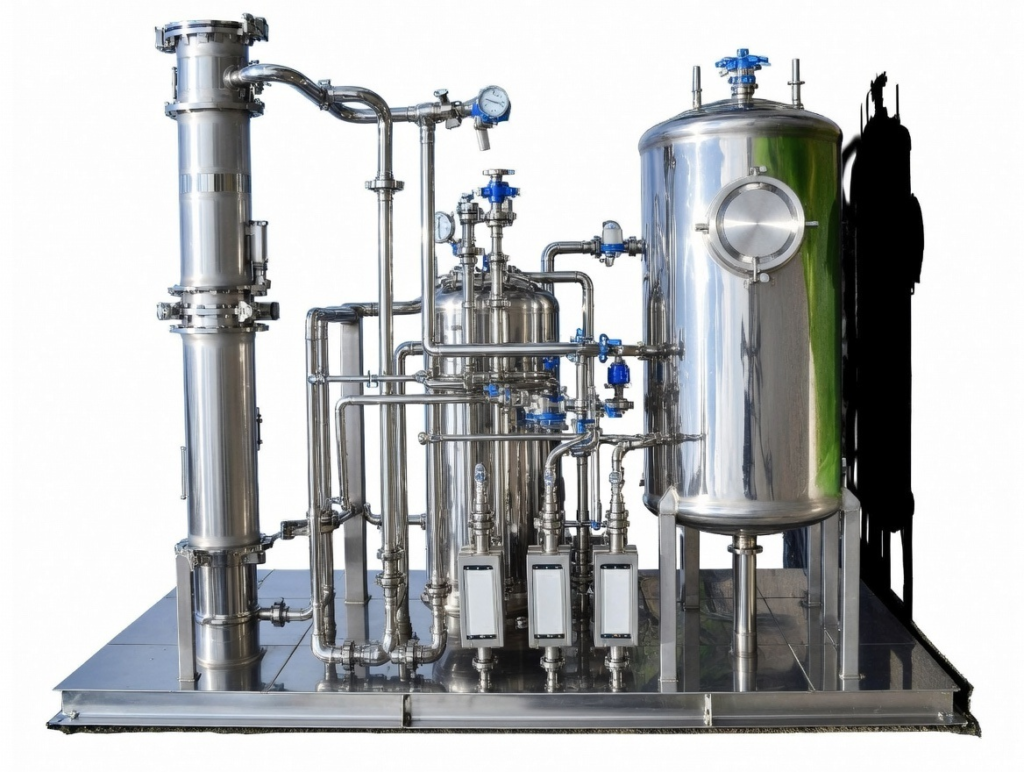
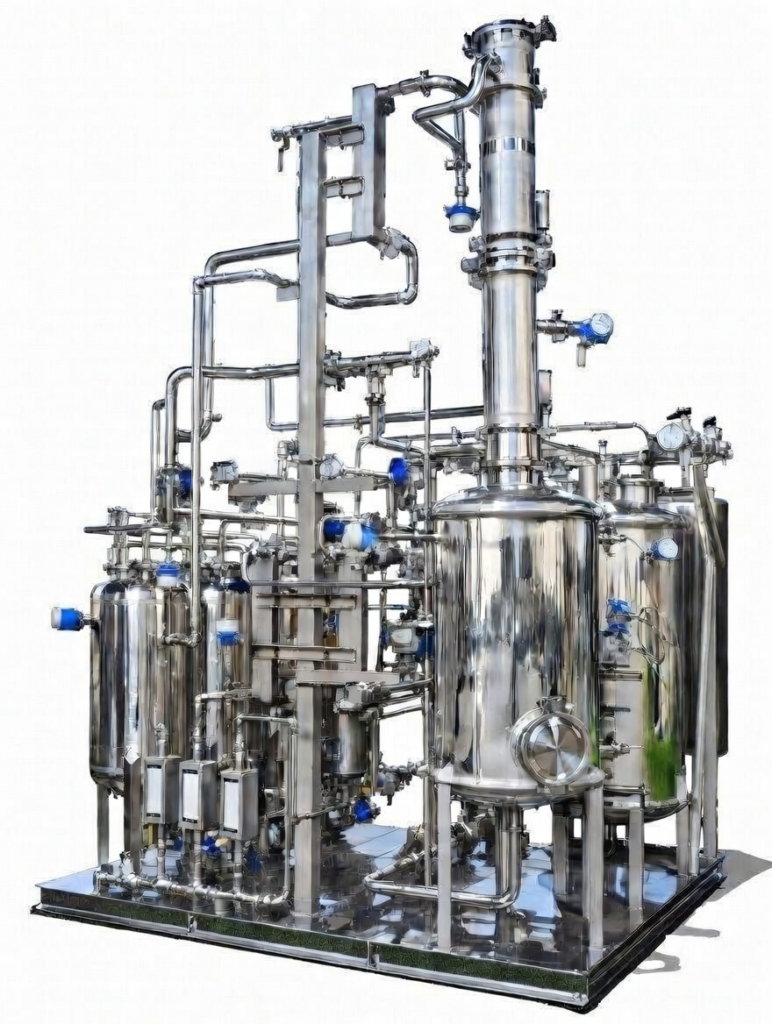
System Design & Key Components
Forced circulation evaporators feature a vertical or horizontal shell-and-tube heat exchanger with a large recirculation loop. Key components include:
- Heating tube bundle (short, wide tubes to minimize scaling)
- High-capacity circulation pump (centrifugal or positive displacement)
- Vapor-liquid separator (cyclone or baffle type) at the top
- External or internal heating jacket/shell with steam/hot water
- Concentrate discharge pump or valve
- Condenser and vacuum system (optional)
Forced Circulation Evaporation Process
The continuous process follows these steps:
- Feed Introduction — Feed liquid mixes with recirculated concentrate in the separator vessel.
- High-Velocity Circulation — Pump forces the mixture at high speed through the heating tubes; heat causes partial evaporation.
- Flash Evaporation — The superheated mixture flashes into vapor-liquid mixture upon entering the separator (lower pressure zone).
- Vapor-Liquid Separation — Vapor rises and exits to the condenser; liquid (concentrate) collects and recirculates or discharges.
- Continuous Operation — Fresh feed enters continuously; concentrate is withdrawn to maintain desired solids level.
Comparisons
| Feature | Forced Circulation Evaporator | Falling Film Evaporator |
|---|---|---|
| Circulation Method | Pump-forced high-velocity flow | Gravity-driven thin film |
| Fouling & Scaling Resistance | Excellent | Good |
| Viscosity Handling | Very high | Low to moderate |
| Best For | High-viscosity, scaling, crystallizing solutions | Heat-sensitive, clean liquids |
| Feature | Forced Circulation Evaporator | Wiped Film Evaporator |
|---|---|---|
| Residence Time | Longer (recirculation) | Extremely short |
| Viscosity Limit | High (up to 50,000 cP) | Very high (up to 100,000 cP+) |
| Best For | Scaling/crystallizing, viscous solutions | Heat-sensitive, very viscous, fouling products |
Typical Operating Parameters
| Parameter | Typical Range | Notes |
|---|---|---|
| Evaporation Rate | 1–50 tons water/h | Scales with tube bundle and recirculation rate |
| Operating Temperature | 60–150 °C | Higher for non-sensitive products |
| Circulation Velocity | 3–6 m/s in tubes | High velocity prevents scaling/fouling |
| Viscosity Limit | Up to 50,000–100,000 cP | Excellent for viscous/crystallizing solutions |
Common Applications & Advantages
| Industry / Application | Typical Process | Primary Goal |
|---|---|---|
| Wastewater / ZLD | Brine concentration, zero liquid discharge | Volume reduction, water recovery |
| Chemicals | Caustic soda, salt solutions, organic acids | Concentration without scaling |
| Sugar & Food | Sugar syrup, molasses, whey concentration | High viscosity handling |
| Mining & Minerals | Leach solutions, tailings water | Solution concentration |
Key Advantages of Forced Circulation Evaporators
- Excellent resistance to fouling, scaling, and crystallization
- Handles high-viscosity and high-solids solutions reliably
- High heat transfer rates due to forced turbulence
- Long operating cycles with minimal cleaning downtime
- Versatile for crystallizing evaporators (e.g., salts)
- Proven in large-scale industrial and ZLD applications