
Azeotropic & Extractive Distillation
azeotropic distillation column
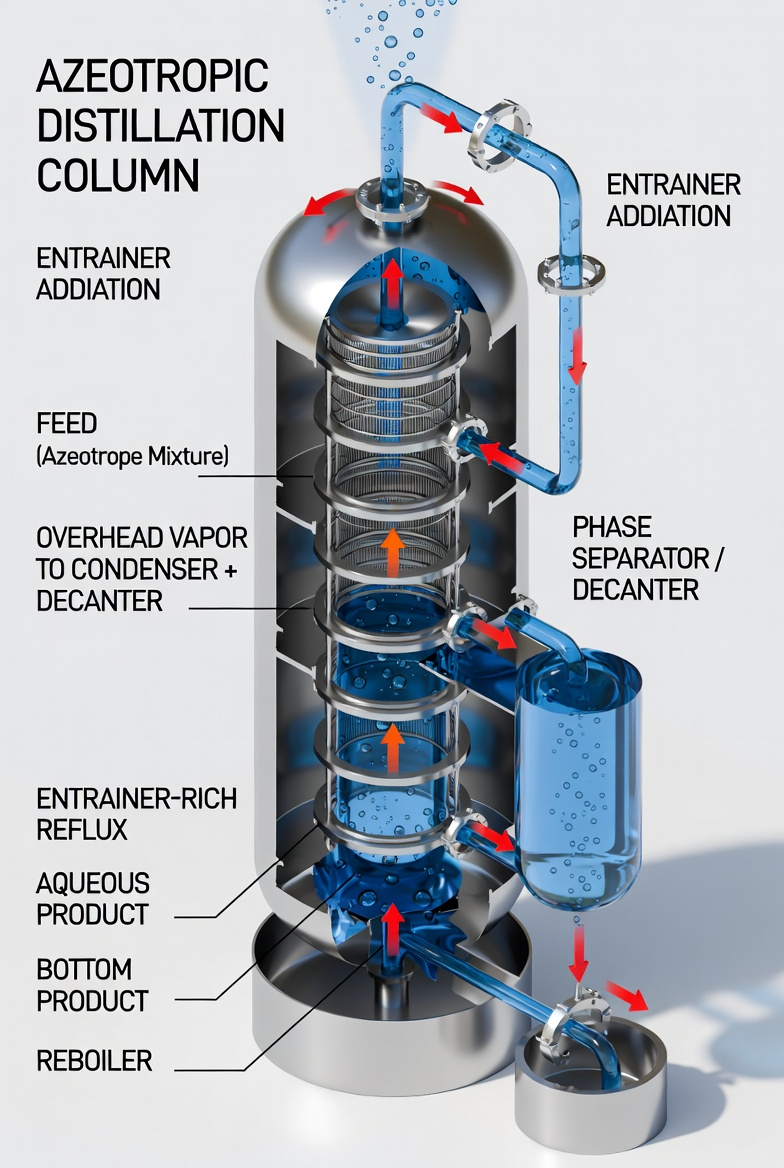
Azeotropic Distillation is a specialized separation process used to break azeotropes — constant-boiling mixtures that cannot be separated by conventional distillation because the vapor and liquid compositions are identical. This technique introduces a third component called an “entrainer” that forms a new, lower-boiling azeotrope with one of the original components, allowing effective separation. The process typically uses two columns. In the first column, the entrainer is added to shift the volatility. The new azeotrope is distilled overhead, while the other component exits as a bottom product with high purity. The overhead azeotrope is then sent to a second column (or decanter) where the entrainer is recovered and recycled.Common entrainers include benzene, cyclohexane, hexane, and isopropanol. The choice of entrainer depends on the chemical nature of the mixture and its ability to form a heterogeneous or homogeneous azeotrope that can be easily separated. Azeotropic Distillation is widely applied in the production of fuel-grade ethanol (dehydration), recovery of tetrahydrofuran (THF), isopropanol (IPA) purification, and many fine chemical processes. It is particularly effective for separating water from organic solvents that form minimum-boiling azeotropes.While highly effective, the process requires careful entrainer selection, precise control, and additional energy for entrainer recovery. SRS International designs optimized azeotropic distillation systems with advanced column internals, energy integration, and reliable solvent management to deliver maximum efficiency, product purity, and long-term operational reliability for industrial applications.
extractive distillation column
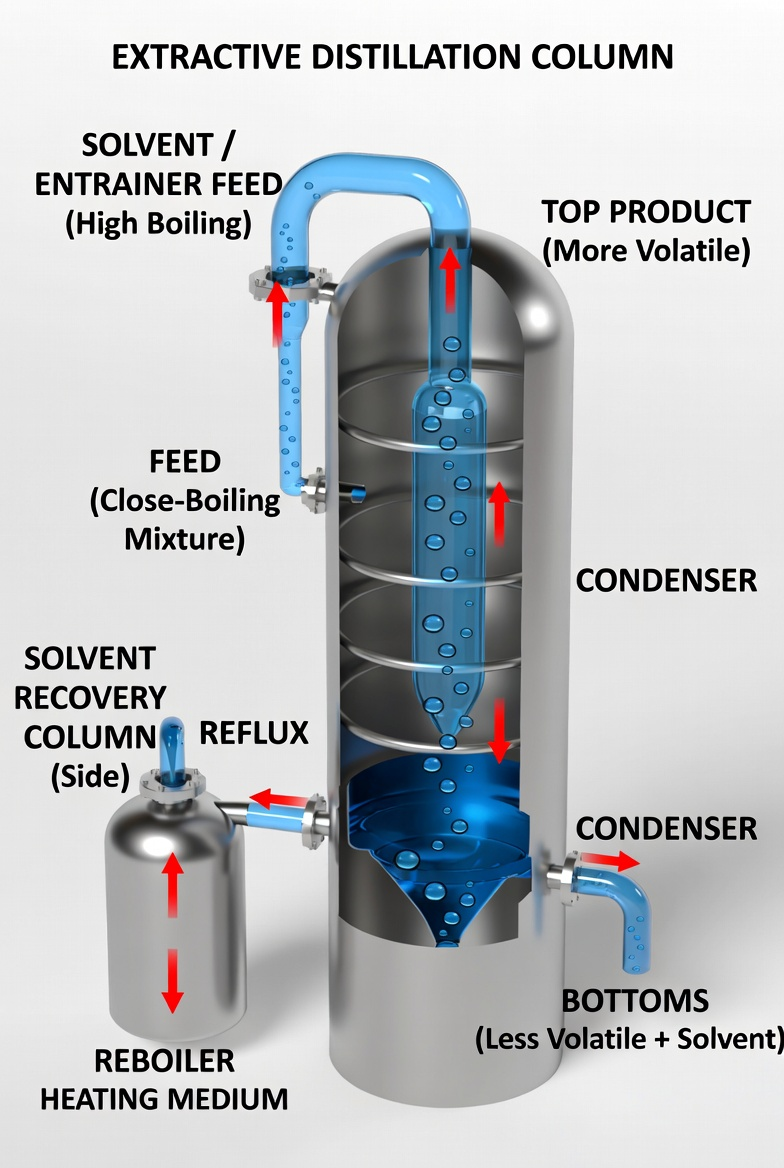
Extractive Distillation is a specialized separation technique used when components have very close boiling points or form azeotropes that cannot be separated by conventional distillation. The process involves adding a high-boiling solvent (called an entrainer) that selectively interacts with one of the components, altering its relative volatility and making separation possible.
In a typical setup, the solvent is introduced near the top of the extractive distillation column. It preferentially associates with one component, allowing the other to be distilled overhead with high purity. The bottom stream, containing the solvent and the extracted component, is then sent to a solvent recovery column where the solvent is separated and recycled back to the main column.
Common solvents include sulfolane, N-methyl-2-pyrrolidone (NMP), dimethylformamide (DMF), and ethylene glycol. These solvents are chosen for their high boiling points, thermal stability, and strong affinity toward specific compounds.
Extractive Distillation is widely used in the petrochemical industry for separating benzene, toluene, and xylene (BTX), butadiene extraction from C4 streams, and purification of close-boiling alcohols and ketones. It delivers exceptional purity levels, often exceeding 99.9%, while offering better energy efficiency than azeotropic distillation in many applications. SRS designs and optimizes extractive distillation systems with advanced column internals, precise solvent management, heat integration, and energy-efficient configurations to minimize operating costs and maximize product quality for demanding industrial processes.