
- Home
- Technologies
- Filtration
- Distillation Columns
- Evaporators
- Liquid to Liquid Extraction
- Centrifuges
- Blending Technology
- Industries
- Services
- Projects
- News
- About SRS
- Contact Us
Bowl Centrifuges
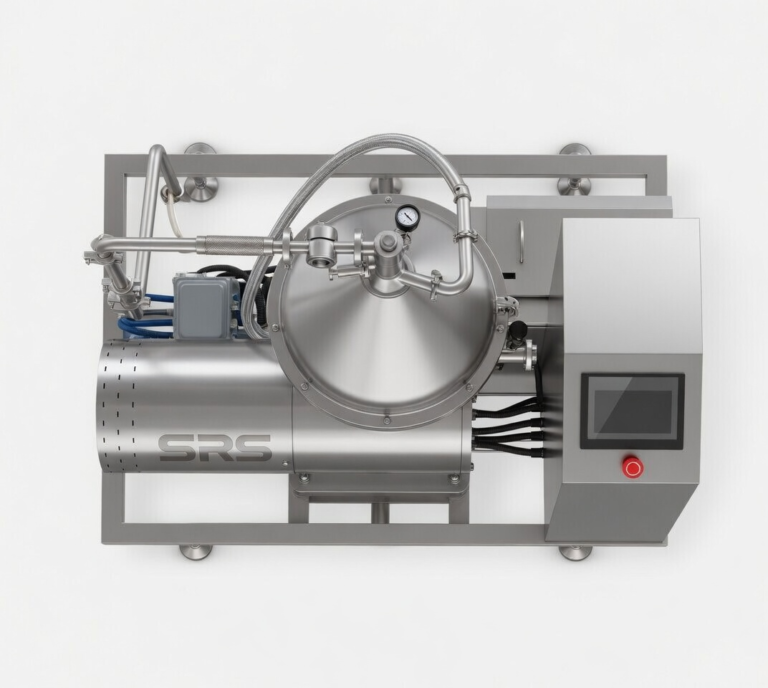
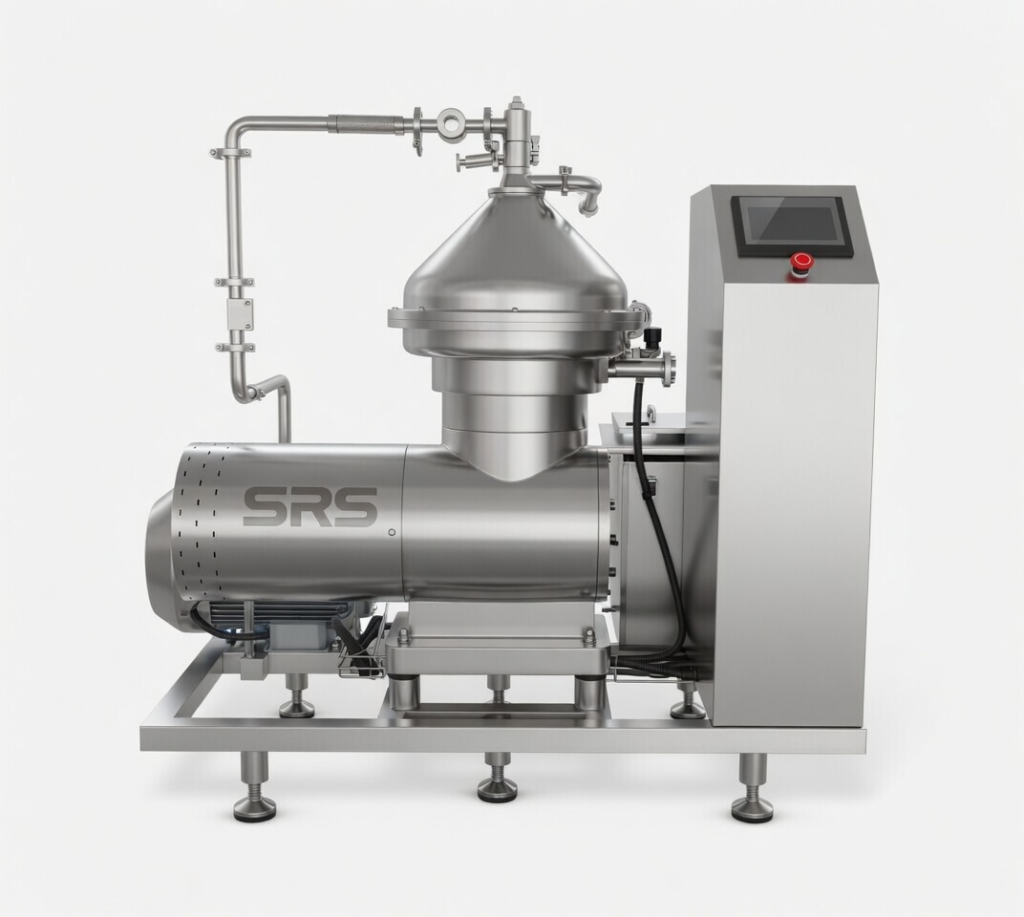
Bowl Centrifuge
High-Speed Clarification & Precision Separation Technology
A Bowl Centrifuge, also referred to as a tubular bowl or disc-stack centrifuge, is a high-speed separation device that utilizes powerful centrifugal forces ranging from 8,000 to 15,000 g. It is specifically engineered for the clarification and polishing of liquids containing low solid content. The equipment consists of a rapidly rotating cylindrical bowl where the feed liquid enters. Due to the extreme centrifugal force, denser solid particles or heavier liquid phases are forced outward to the bowl wall, while the clarified liquid flows toward the center and exits through dedicated outlets.
Bowl centrifuges are renowned for their exceptional separation efficiency, capable of removing sub-micron particles that cannot be separated by gravity or conventional filtration. They are widely used in industries where product clarity and purity are paramount, such as pharmaceutical manufacturing (cell harvesting, protein separation, vaccine production), biotechnology, beverages (juice clarification, beer polishing), edible oils, and fine chemicals.
Technical Specifications
| Parameter | Typical Range |
|---|---|
| Centrifugal Force | 8,000 – 15,000 g |
| Bowl Speed | 8,000 – 20,000 RPM |
| Solids Content | Less than 5% (optimal < 1%) |
| Flow Rate | 50 – 2,000 liters per hour |
| Separation Efficiency | Up to 99.9% for sub-micron particles |
The main advantage of bowl centrifuges lies in their ability to deliver extremely high clarity liquids with minimal residual solids. However, they generally operate in batch or semi-continuous mode, requiring periodic bowl discharge or cleaning. Modern disc-stack bowl centrifuges feature automatic solids ejection systems for improved continuous operation. Their compact footprint, high separation performance, and sanitary design make them indispensable in high-value manufacturing processes where product purity is non-negotiable.
Bowl Centrifuge – Technical Specifications
High-Performance Clarification System
Bowl Centrifuges are precision-engineered high-speed separators designed for clarification, polishing, and liquid-liquid separation in industries requiring ultra-high purity and low residual solids.
Technical Specifications
| Parameter | Typical Range | Standard / High-Performance |
|---|---|---|
| Centrifugal Force | 6,000 – 15,000 g | 12,000 – 15,000 g |
| Bowl Speed (RPM) | 8,000 – 22,000 RPM | 15,000 – 20,000 RPM |
| Bowl Volume | 0.5 – 30 liters | 2 – 15 liters |
| Flow Rate Capacity | 50 – 5,000 L/H | 200 – 2,500 L/H |
| Solids Content (Feed) | 0.1% – 5% | 0.1% – 2% |
| Separation Efficiency | Up to 99.9% (sub-micron particles) | 99.5% – 99.99% |
| Discharge Type | Manual, Semi-automatic, Fully automatic (self-cleaning) | Automatic intermittent discharge |
Key Design Features
| Feature | Benefit |
|---|---|
| Disc Stack Technology | Increases settling area dramatically for superior clarification |
| Hermetic / Sealed Design | Prevents oxidation and contamination (ideal for pharmaceuticals) |
| CIP / SIP Compatible | Fully cleanable in place for sanitary applications |
| Variable Speed Drive | Allows optimization for different products |
Bowl Centrifuges deliver unmatched clarity and are the preferred choice for high-value, low-solid clarification processes in biotechnology, pharmaceuticals, and premium food & beverage production.
Bowl Centrifuge Efficiency Chart
Performance Comparison – High-Speed Clarification
Bowl Centrifuges deliver exceptional separation efficiency through extreme centrifugal forces. Below is a detailed performance comparison.
| Parameter | Gravity Settling | Filter Press | Decanter Centrifuge | Bowl Centrifuge |
|---|---|---|---|---|
| Centrifugal Force | 1 g | — | 2,000 – 4,500 g | 8,000 – 15,000 g |
| Particle Size Removal | > 50 μm | 1 – 10 μm | 2 – 10 μm | 0.1 – 1 μm |
| Clarified Liquid Turbidity | High | Low | Medium | Very Low (< 1 NTU) |
| Solids Content (Feed) | Any | Medium-High | High | Low (< 5%) |
| Separation Efficiency | 40 – 60% | 85 – 95% | 90 – 96% | 98 – 99.9% |
| Throughput Capacity | Low | Medium | High | Medium-High |
Conclusion: Bowl Centrifuges provide the highest clarification efficiency and finest particle removal, making them the superior choice for polishing and high-purity applications.
Bowl Centrifuge Applications
High-Clarity Separation for Critical Industries
Bowl Centrifuges excel in applications requiring ultra-high clarity, sub-micron particle removal, and superior liquid polishing. Their high G-force makes them ideal for low-solid content streams where maximum purity is essential.
| Industry | Key Applications | Benefits Achieved |
|---|---|---|
| Biotechnology & Pharmaceuticals | Cell harvesting, bacteria separation, protein clarification, vaccine production, blood plasma fractionation | Ultra-high purity, sterile conditions, high recovery rates |
| Food & Beverage | Juice clarification, beer polishing, wine fining, edible oil polishing, dairy processing | Crystal clear liquids, extended shelf life, improved taste & appearance |
| Essential Oils & Fragrances | Essential oil clarification, flavor extraction, natural extract polishing | Preservation of delicate aromas and volatile compounds |
| Fine Chemicals & Solvents | Catalyst recovery, solvent clarification, high-purity chemical polishing | High product purity, reduced downstream filtration |
| Wastewater & Environmental | Fine particle removal, microalgae harvesting, process water polishing | Extremely low turbidity effluent |
Summary: Bowl Centrifuges are the gold standard for high-value, low-solid clarification processes where maximum purity, clarity, and product quality are non-negotiable.
Bowl Centrifuge – Frequently Asked Questions
Common Questions Answered
| Question | Answer |
|---|---|
| What is a Bowl Centrifuge? | A Bowl Centrifuge is a high-speed separator that uses powerful centrifugal force (8,000–15,000 g) to clarify liquids and remove fine particles or separate two immiscible liquids. |
| What is the main difference between Bowl and Decanter Centrifuges? | Bowl centrifuges are designed for low-solids clarification with very high G-force, while Decanter centrifuges are for continuous dewatering of high-solid slurries. |
| What particle size can a Bowl Centrifuge remove? | It can efficiently remove particles as small as 0.1 – 1 micron, delivering very high clarity. |
| What industries use Bowl Centrifuges? | Pharmaceuticals, biotechnology, food & beverage, essential oils, fine chemicals, and premium edible oil processing. |
| Is it continuous or batch operation? | Most bowl centrifuges operate in batch or semi-continuous mode. Modern disc-stack models offer automatic intermittent discharge for near-continuous operation. |
| What maintenance is required? | Regular bowl cleaning, bearing lubrication, and vibration monitoring. Automatic discharge models require less manual intervention. |
| Can it handle high temperatures or corrosive liquids? | Yes, with proper material selection (Stainless Steel, Duplex, Titanium, or Hastelloy), they can handle a wide range of temperatures and corrosive fluids. |
Bowl Centrifuge – Advantages & Disadvantages
Balanced Evaluation of High-Speed Bowl Centrifuges
| Advantages | Disadvantages |
|---|---|
| • Extremely high separation efficiency (sub-micron particles) • Produces very clear, polished liquid output • Compact footprint compared to other separators • Excellent for high-value, low-solid streams • High recovery rates of valuable products • Sanitary design suitable for pharmaceutical use • Fast processing and quick startup | • Limited to low solids content feeds (< 5%) • Usually batch or semi-continuous operation • High maintenance due to high rotational speeds • Higher energy consumption per volume processed • Requires skilled operators and precise balancing • Bowl cleaning or disassembly can be time-consuming • Sensitive to feed variations |
Bowl Centrifuges are the preferred technology when maximum clarity and purity are required in low-solid applications. Their high G-force delivers unmatched performance, though they are best suited for clarification rather than heavy dewatering tasks.